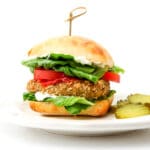
Vegan Chicken Patties
Homemade breaded and baked vegan chicken patties to be used for chicken sandwiches or as a breaded vegan chicken breast.
Servings 6
Calories 353kcal
Ingredients
For the "chicken"
- 1 1/2 cups chickpeas (15.5 oz can) drained or white beans or 14 oz. firm pressed tofu
- 1 cup not chick'n broth (reconstituted) or other vegan chicken style broth
- 2 tablespoons nutritional yeast (optional)
- 2 tablespoons neutral-flavored oil
- 1 1/2 teaspoon poultry seasoning
- 1 1/4 teaspoon salt
- 1/2 teaspoon onion powder
- 1/2 teaspoon garlic powder
- 1 1/3 cup vital wheat gluten
For the coating
- 1/2 cup panko bread crumbs or crumbled crackers, vegan stuffing, or cornflakes.
- 1/4 cup flour
- 1 tablespoons corn starch
- 1 tablespoon nutritional yeast (optional)
- 2 teaspoons poultry seasoning or other dry herbs of choice
- 1/2 teaspoon salt
To get the patty wet
- 1/2 cup plant-based milk or aquafaba (the liquid from the can of beans that you used.)
To oil the cookie sheet
- 3 tablespoons neutral-flavored oil
Instructions
Make the dough
- Add a can of drained chickpeas to a food processor or blender along with broth, nutritional yeast, oil, poultry seasoning, garlic powder, onion powder, and salt.
- Blend until smooth, then transfer to a glass mixing bowl.
- Stir in 1 cup of the vital wheat gluten, then add the remaining 1/3 cup of wheat gluten and knead with your hands for about 1 minute, until a firm dough forms. *Don't eat it until it has been cooked.
- You can now cook your seitan, or, for a "chicken" with a stringier texture, let it rest in the fridge, covered, for at least 1 hour or up to 24 hours.
Make the breading
- Preheat the oven to 375°F (190 °C). Put about 3 tablespoons of neutral-flavored oil on a large cookie sheet, ensuring the bottom is completely covered, and set it aside.
- Mix together the bread crumbs, flour, corn starch, nutritional yeast, herbs, and salt in a shallow bowl.
- Pour vegan milk (or aquafaba) into another shallow bowl to dip the dough in, wetting it so the breading will stick.
Bake the patties
- Divide the dough into 6 equal pieces, then form them into the desired shape by hand.
- Place the patty in the vegan milk to moisten it, then place it in the dry breading, pressing the dough into the breading to coat it well.
- Place the patty on the oiled cookie sheet and repeat until you have coated all of the chicken patties in the breading.
- Bake the patties at 375° F (190° C) for 16-18 minutes, then take them out of the oven, flip each one, and place them back in the oven for another 16-18 minutes until golden brown.
Video
Notes
- You can use any type of bean or tofu, blended with the broth to make the vegan chicken.
- For a stringier chicken texture, allow your dough to rest in the fridge for at least an hour before forming it into nuggets.
- Gluten needs to be cooked; don't eat it raw. You know it has cooked enough when it is firm and meat-like and no longer has a doughy texture.
- Wheat gluten is a very fine powder that can get messy. When pouring the flour into the bowl, hold it low so it doesn't splash out or raise a cloud of dust.
- Use only a glass bowl and silicone spatula. Wet gluten is very sticky and hard to clean.
- Wash your bowl and utensils in very hot water. This will help to reduce the stickiness of the gluten. You may want to use an old rag that you can throw away after you clean up.
Nutrition
Serving: 1g | Calories: 353kcal | Carbohydrates: 29g | Protein: 28g | Fat: 15g | Saturated Fat: 2g | Sodium: 961mg | Potassium: 286mg | Fiber: 5g | Sugar: 4g | Vitamin A: 202IU | Vitamin C: 2mg | Calcium: 118mg | Iron: 4mg